Materials & Sleep
Choosing an Organic Latex Topper: Materials, Feel, and Certifications
A latex topper can soften a firm mattress, refine pressure relief, and change the character of a bed without replacing its foundation. But the words “natural” and “organic” tell only part of the story. Latex type, processing, cover fabric, construction, and the precise scope of any certification all deserve a closer look.
An organic latex topper is often chosen for its buoyant, responsive feel: it cushions the body while making it easier to shift position than on many slow-recovery foams. Yet no single latex topper feels a certain way simply because it is latex. Firmness, thickness, manufacturing method, and the layers surrounding the latex can all influence how it performs on a particular mattress.
Thoughtful shopping begins with a practical question: what do you want to change about your current sleep surface? If it feels too firm, a softer topper may add cushioning. If it already feels too soft or allows the hips to sink, another plush layer may make the problem more pronounced. A topper can tune the feel of a mattress, but it cannot reliably repair a worn-out or unsupportive one.
It also helps to read material claims with precision. A product may contain natural rubber latex, an organic cotton cover, or a component certified to an organic standard. Those statements do not automatically mean that every material, treatment, accessory, or part of the finished product has the same certification. The details matter—not as fine print to be skimmed, but as the clearest guide to what you are actually buying.
What an organic latex topper is made of
Latex foam used in bedding is made from rubber, usually derived from the milky sap of the rubber tree, Hevea brasiliensis. The sap is collected and processed into a resilient material with a springy, elastic character. In a topper, a latex layer generally sits between the mattress and the fitted sheet, adding a new comfort layer while leaving the underlying mattress in place.
The word “organic” needs context. It can describe how a particular agricultural raw material was produced, or it may refer to a product or component that has been assessed under a named standard. It is not, by itself, a complete description of the finished topper. Ask which part is certified, which organization issued the certification, and whether the claim applies to the latex, the cover, or the finished article.
A typical topper can include a latex core, a fabric cover, and sometimes additional materials such as thread, elastic, or a zipper. These elements have different functions and may have different material origins. A transparent product description separates them rather than presenting a broad sustainability phrase as though it answers every sourcing question.
For readers tracing a bedding material from farm to mattress, this distinction is especially useful. The rubber tree is only the beginning of the story. Processing, manufacturing, transport, the durability of the finished layer, and its care requirements all contribute to a fuller understanding of the product.
Talalay and Dunlop: two common manufacturing approaches
Two names commonly used to describe latex manufacturing are Talalay and Dunlop. They refer to different processes, not a simple quality ranking. Both can produce latex foam, and both can appear in products described as natural or organic. The name of the process does not tell you everything about a topper’s composition, firmness, or certification; those details should be checked separately.
In broad terms, Talalay production involves placing a measured amount of latex into a mold, drawing a vacuum to distribute it, freezing it, and then curing it. Dunlop production generally involves pouring latex into a mold and curing it without the same vacuum-and-freeze steps. These process differences can contribute to variations in structure and feel, but the final experience also depends on the particular formulation, density, and design.
It is tempting to turn the comparison into a set of absolutes—one method is always softer, cooler, or more durable than the other. In reality, firmness labels and user experience vary by manufacturer and product. For a shopper, the useful questions are direct: what is the stated firmness, how thick is the layer, what does the manufacturer say about the feel, and is there a return or exchange policy that allows you to assess it at home?
A product listing may identify its latex as Talalay or Dunlop while using separate language for its raw material. “Natural Talalay,” for example, describes both a source-related claim and a process name, but it is not interchangeable with a third-party organic certification. Look for the supporting documentation before treating these terms as proof of the same thing.
How latex feels on the bed
Latex is valued for a responsive, gently buoyant feel. Instead of slowly settling around the body, it tends to compress and spring back more quickly. Many sleepers describe this as cushioning that remains easy to move across. The sensation is distinct from the close, slower contouring often associated with memory foam, though the precise difference depends on the product and on the mattress underneath.
That responsiveness can be appealing to combination sleepers who change positions during the night. It may also suit people who want a softer surface without feeling deeply enveloped. But “responsive” is not another word for universally comfortable. A topper that feels supportive to one person may feel too springy, too firm, or too yielding to someone else.
Consider how you sleep and where you feel pressure. Side sleepers often look for enough cushioning at the shoulder and hip, while back sleepers may prefer a surface that cushions without allowing excessive sinking at the pelvis. Stomach sleepers commonly need to be cautious about adding too much softness, since a plush layer can alter how the body rests on the mattress. These are general considerations rather than guarantees: body shape, mattress firmness, and personal preference all play a part.
When evaluating a firmness description, remember that “soft,” “medium,” and “firm” are not universal measurements across brands. A three-inch soft latex layer can feel very different from a thinner medium layer, and the underlying mattress affects the combined result. If possible, compare specifications and policies—not adjectives alone.
Thickness, firmness, and construction
Thickness is one of the most noticeable choices. A thinner topper generally makes a more subtle adjustment, while a thicker one can create a more pronounced change in surface cushioning. More thickness does not automatically mean better pressure relief or improved support. It can also make a mattress feel less stable or alter the way your body settles into the bed.
Start by identifying the problem you hope to solve. If the mattress is basically supportive but slightly too firm, a modest layer may be sufficient. If it is substantially uncomfortable, first consider whether its support has deteriorated or whether the firmness is fundamentally mismatched to your needs. A topper cannot make a sagging mattress level, and adding softness to an already unsupportive bed may not produce a more comfortable result.
Construction details affect use as well as feel. Some latex toppers have a removable fabric cover; others have a cover that is not designed to be removed. A stretch-knit cover can move with the latex and preserve more of its surface response, while a more structured fabric may contribute a different hand and feel. Ask whether the cover is included, what it is made from, and how it should be cleaned.
Check the topper’s finished dimensions against the mattress, including the depth of any existing protector and fitted sheet. Adding a topper raises the bed and may affect sheet fit, especially if the mattress already has a substantial profile. A well-chosen layer should sit securely and evenly rather than shifting or bunching during the night.
Airflow and temperature expectations
Latex is often selected by people seeking a less enveloping feel than some other foams offer. Its springy surface and open structure may contribute to a different sleep experience, but no material can promise that every sleeper will stay cool. Bedroom temperature, mattress design, sheets, blankets, humidity, and individual heat sensitivity all influence comfort.
Think of breathability as one feature in a sleep system rather than a stand-alone temperature solution. A latex core inside a dense or heavily quilted cover may feel different from a more lightly covered layer. Likewise, a waterproof protector or thick insulating bedding can affect heat and moisture movement at the surface. Check the full set of layers, not just the material named in the headline.
Natural fibers in the cover may also influence the hand and moisture experience, but fiber content alone does not settle the question. Weave, knit, fabric weight, and finishing can change how a textile feels and behaves. Product care instructions are equally important: using high heat or unsuitable cleaning methods may shorten the life of a cover or affect its fit.
Understanding organic and material certifications
Certifications can help make material claims more specific, but they are useful only when you know what they cover. A certified organic cotton cover does not establish that the latex core is certified organic. A certified latex component does not automatically establish that every textile, zipper, thread, or other element has been assessed under the same program. The product page or label should identify the certified component and the applicable standard.
For organic claims, look for the name of the certification program, the certificate holder, and a current certificate or other traceable documentation. If the seller uses a certification logo, the logo should be accompanied by enough information to verify the scope of the claim. When information is unclear, ask whether the certification applies to the raw material, processing, a component, or the complete finished product.
Different certifications address different questions. Some standards focus on organic agricultural production and processing; others assess chemical emissions, restricted substances, or environmental and social criteria within a defined scope. One label should not be treated as a universal guarantee of every desirable quality. Read the standard’s purpose and boundaries, then consider whether it answers the question you care about.
It is also important to separate the phrases “natural latex” and “organic latex.” “Natural” commonly indicates that the material is derived from rubber-tree latex, but it does not, on its own, confirm organic agricultural practices or a particular independent assessment. “Organic” should be supported by a named, relevant certification rather than used as an unqualified synonym for natural.
Certification is one part of transparency, not a substitute for it. A useful product description gives you the material breakdown, manufacturing method where available, country or region of origin when known, care directions, and warranty terms. It should also make clear where information is unavailable instead of allowing a broad environmental claim to imply more than the documentation supports.
A natural latex topper to compare
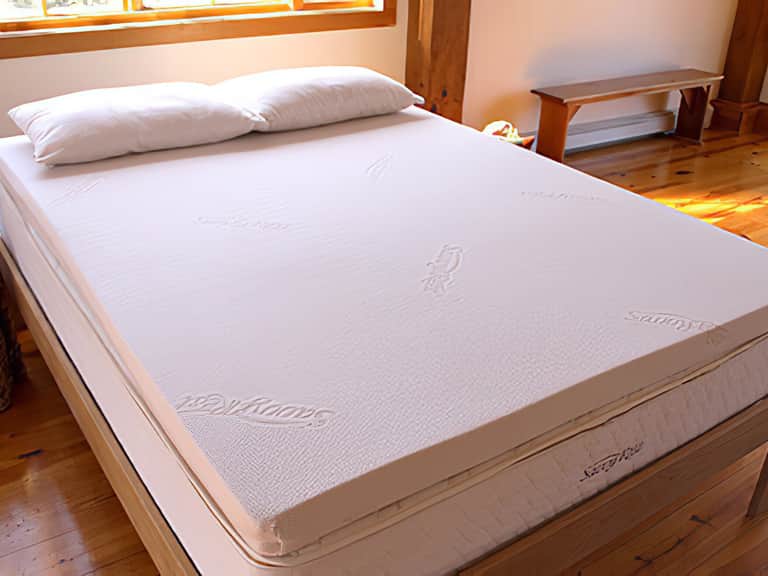
One example to examine is the Savvy Rest Vitality Latex Mattress Topper. Its product information describes a three-inch layer of soft natural Talalay latex in a certified organic cotton stretch-knit casing. It is presented as a cushioning option for a mattress that feels too firm, and the listed warranty is three years.
Those specifications offer a practical starting point for comparison: latex type, thickness, stated firmness, cover material, and intended comfort change are all identified. As with any organic or natural latex topper, shoppers who need to verify a claim should check the current product documentation to establish exactly what is certified and whether the certification applies to the cover, the latex, or another defined component. A product description is useful, but the scope of a certification should be confirmed rather than assumed.
Its three-inch thickness is a meaningful consideration if you are trying to make a small adjustment rather than substantially change the bed. Think about your existing mattress, your preferred sleeping position, and whether the topper’s stated softness aligns with the specific issue you want to address. Comfort remains personal, so the return terms and care instructions are worth reviewing before purchase.
Care, durability, and everyday practicality
Latex toppers are not all cared for in the same way. Follow the manufacturer’s instructions for the latex core and the cover; do not assume either part is machine washable. Some covers are removable and washable, while others require spot care. The core may need to be kept dry and protected from direct heat, sunlight, or harsh cleaning products, depending on the specific guidance.
A mattress protector can help limit contact with spills, sweat, and everyday soil, but confirm that the protector fits over the topper and mattress together. Too-tight bedding can compress or distort layers, while a loose fitted sheet may shift. Check the total depth before choosing sheets and protective bedding.
Durability depends on material quality, use, construction, and care. A warranty describes the manufacturer’s stated coverage and limitations; it is not a prediction that every product will feel unchanged for a particular number of years. Read what the warranty covers, how defects are assessed, and whether normal changes in comfort are excluded.
Environmental considerations also extend beyond a label. A topper that remains comfortable and functional for a long time may avoid premature replacement, but end-of-life options vary by material, location, and local waste systems. Ask about packaging and disposal or recycling guidance where relevant, and avoid assuming that a natural-origin material can automatically be composted or recycled in ordinary household conditions.
A practical checklist before choosing
- Define the goal: Decide whether you want more cushioning, a softer surface, a different feel, or a modest comfort adjustment.
- Assess the mattress beneath it: A topper can modify surface feel, but it cannot correct sagging or restore lost support.
- Compare thickness and firmness together: These specifications interact, and brand-to-brand labels are not standardized.
- Identify the latex: Look for the stated manufacturing method and a clear description of natural or organic content.
- Check certification scope: Verify which component is certified and which organization or standard supports the claim.
- Read the full material breakdown: Include the cover, fasteners, and other components where information is provided.
- Confirm fit: Check mattress dimensions, total bed depth, fitted-sheet compatibility, and whether the topper is likely to stay in place.
- Review care and warranty terms: Know how the cover and core should be maintained, and what the warranty actually covers.
- Consider the trial or return policy: A home trial can be especially useful when firmness and feel are difficult to judge from specifications alone.
For a more careful comparison, keep notes on each option rather than relying on phrases such as “luxury,” “eco-friendly,” or “cooling.” Record the material, process, thickness, firmness, cover, certification scope, and care requirements. That simple habit makes product descriptions easier to evaluate side by side.
Frequently asked questions
Is natural latex the same as organic latex?
No. Natural latex generally describes a material derived from rubber-tree sap. Organic claims relate to specified production and processing requirements and should be supported by a relevant certification. Check the documentation to see which component is covered.
Will a latex topper make a firm mattress feel softer?
A softer latex layer can change the surface feel and add cushioning. The result depends on its thickness and firmness as well as the mattress underneath. It may not resolve discomfort caused by an old, damaged, or poorly supportive mattress.
Does a certification cover the entire topper?
Not necessarily. A certification might apply only to the latex, only to the cover fabric, or to another defined part of the product. Check the certificate and product documentation rather than assuming that one certified component makes the whole topper certified.
Is Talalay always softer than Dunlop?
No simple rule can establish the feel of every product based on process name alone. Firmness, formulation, layer design, and manufacturer specifications all matter. Compare the stated firmness and thickness, and use a trial policy when available.
Can I wash a latex topper?
Care instructions vary. The cover may have different requirements from the latex core, and some covers are not removable. Follow the specific manufacturer’s guidance and avoid soaking or applying cleaners to the core unless the instructions explicitly permit it.
The considered choice
The appeal of an organic latex topper lies in the meeting of material, sensation, and intention: a springy comfort layer, a potential route to better surface cushioning, and an opportunity to ask more considered questions about sourcing. The best choice is not necessarily the softest, thickest, or most lavishly described. It is the one whose construction addresses a real comfort need and whose claims can be understood and verified.
Compare latex type and manufacturing method, but do not let either stand in for a full specification. Evaluate firmness and thickness in relation to your mattress. Read the certification carefully, paying attention to the component it covers. Finally, check fit, care, warranty, and return terms. With those details in view, a topper becomes less of a leap of faith and more of a thoughtful adjustment to the bed you already have.